


 Sabri Deniz Martin
1 min read
EU AI Act: Why AI expertise is now mandatory
 Florian Fieber
EU AI Act focuses on "AI literacy" With the entry into force of the EU AI Act on August 1, 2024 - and the start of application of important...

Practical. Proven to success. Tailor-made. Learn more about our case studies.

In modern software development, one thing counts above all else: speed. Trends such as "vibe coding" allow features to be published more quickly. Developers describe a function - the "vibe" - and AI assistants generate the appropriate code in a matter of seconds. This promises an enormous gain in efficiency. But this is exactly where a development begins that we at TestSolutions view with a mixture of interest and professional caution. It leads us directly to the Jevons paradox: more and more code means increasing complexity and greater susceptibility to errors. We know how to counter this.
Jevons' paradox, an economic principle from the 19th century, teaches us that an increase in efficiency in the use of a resource does not lead to less, but to more overall consumption. Applied to software development, this means that because we produce code faster and more easily thanks to AI tools, the total volume of software developed increases exponentially. The number of cycles increases, the complexity of the systems and their dependencies grow - and thus inevitably also the potential susceptibility to errors.
This acceleration has a dangerous downside. An error that is overlooked in the early development phase causes significantly higher costs, particularly at the integration or acceptance test level. Our practical experience from countless customer projects clearly confirms the study situation: the later a bug is found in the Software Development Life Cycle (SDLC), the more expensive and time-consuming it is to rectify.
The costs do not increase linearly, but exponentially:
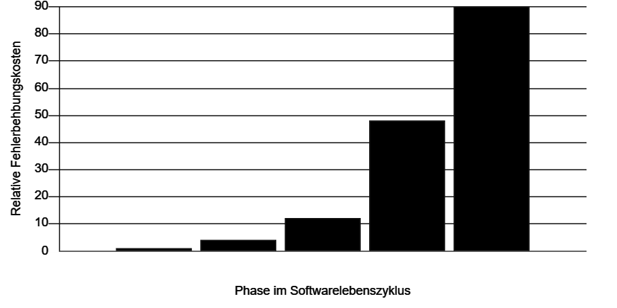
To proactively counteract this cost explosion, the "shift-left" approach is not an option, but a necessity. Quality assurance must not be the gatekeeper at the end of the process. At TestSolutions, we anchor testing as early as possible in the development process. By systematically checking requirements, architectures and the first code increments, we catch errors before they can become deeply embedded in the system and trigger expensive domino effects. This is the basis of modern, agile quality assurance.
Don't get us wrong: artificial intelligence is a fantastic tool. It can free developers from repetitive tasks and deliver initial drafts in record time. However, the danger lies in blind trust. An AI is a tool, not an expert. Without critical thinking and precise control, the result can quickly be unclean, error-prone or simply wrong.
The increased development speed brought about by AI must be flanked by equally fast and intelligent quality assurance. This is where we come in with AI-supported test automation. We use intelligent tools to accelerate test case creation, generate realistic test data and use adaptive scripts to keep up with the high pace of development. We match the speed of code creation with the speed of code review.
The dream of fully automated tests without human intervention is not new - and has always failed to materialize. We are convinced that AI will not fundamentally change this.
Find out why in our blog article: From automation to AI: lessons learned from old testing trends 📚
The key point is that even the best AI-supported test automation cannot replace human test experts. It is a powerful tool, but it cannot and must not assume final responsibility. A tool tests what it is told to do. It does not ask critical questions. It does not interpret the "spirit" of a requirement in the multidimensionality inherent in human critical thinking.
This is precisely where the core competencies of our certified test engineers lie:
Our partners agree with us: testers are still needed. See the blog post by AskUI GmbH, whose AI-supported test automation solutions we often integrate as a component of our test infrastructure:
Announcing Our Partnership with TestSolutions: The Future of AI-Powered Test Automation 📚
Ultimately, it is the human tester who takes responsibility and uses their expertise to ensure that software is not only developed quickly, but is also correct, secure and adds value for the end user.
The future of quality assurance does not lie in the question of "human or AI?". It lies in the intelligent symbiosis of both. And that is precisely the approach we take at TestSolutions: Experienced test engineers equipped with the best AI-powered tools to make your software better.
We'd love to hear your thoughts on the impact of AI on software testing.
Please get in touch.


1 min read
EU AI Act focuses on "AI literacy" With the entry into force of the EU AI Act on August 1, 2024 - and the start of application of important...
1 min read
There's a widespread assumption quietly spreading through software development teams: AI tools are so good now that testing becomes less critical....
1 min read
AI-supported chatbots are revolutionizing customer service: they enable companies to offer their customers fast, personalized support around the...
 Sabri Deniz Martin