


1 min read
TestSolutions at Aviation Festival Asia 2026 in Singapore
 Sabri Deniz Martin
In March 2026, TestSolutions GmbH took part in the Aviation Festival Asia in Singapore, one of the most important international conferences for...

Practical. Proven to success. Tailor-made. Learn more about our case studies.
3 min read

In today's highly networked digital ecosystems, user expectations are immensely high. A delay of just 500 milliseconds can already significantly reduce conversion rates. Increasing response times can also trigger a chain reaction in the entire microservices landscape.
As load and performance testers , we no longer focus our testing activities purely on throughput. Instead, our test purpose aims to improve the resilience of systems under uncertain operating conditions. This is exactly where AI-supported load and performance testing comes in.
It does not replace human expertise, but enhances it in a targeted manner: through automated pattern recognition, accelerated error localization and the shift from reactive troubleshooting to proactive measures.
The shift towards distributed architectures - such as microservices, Kubernetes and serverless - has made traditional test models and test cycles obsolete. Static test baselines and rigid test schedules are no longer fit for purpose.
Instead, we need today:
Artificial intelligence enables precisely these three points and is already changing the way modern development teams develop and deliver software.
We have integrated AI-supported test tools into our test processes to eliminate typical causes of errors: from sporadic latency peaks and unpredictable memory behavior ("garbage collection") to bottlenecks in the CI/CD pipeline and regressions that only become apparent under load conditions.
| Tool | Role in the pipeline | AI functions |
Why we use it
|
| NeoLoad | Load & performance tests | Automatically adjusted test loads, prediction of SLA violations |
Visual test design + enterprise scalability
|
| JMeter | Open source load simulation | Plugin-based extensions for adaptive testing |
High customizability, easy Git integration
|
| Gatling | High load simulation | Predictive modeling via Gatling FrontLine |
Ideal for API stress testing at protocol level
|
| Prometheus | Metrics collection | Rule-based detection, ready for ML integrations |
Lightweight & scalable for container metrics
|
| Grafana | Visualization & dashboards | Trend forecasting, AI-powered alert tuning via plugins |
Actionable insights + real-time dashboards
|
| GitLab CI | CI/CD automation | Enforcement of test thresholds, triggering of dynamic workflows |
Seamless performance gates in the pipeline
|
We have evolved from pure test execution to continuous performance validation.
Our test process now looks like this in some projects:
This closed feedback loop, enhanced by AI, ensures thatevery release meets the performance targets - with minimal manual intervention during the test cycles.
Despite its potential, AI is not a panacea in load and performance testing.
There are clear limitations that we must not ignore:
At its core, AI is a valuable support for software testing, but it does not replace the know-how of subject matter experts.
Only the combination of "intelligent" technology and professional understanding as well as in-depth technical skills delivers truly reliable results.
The use of AI in performance engineering is more than just a technical upgrade - it is a decisive factor for business success.
Once properly integrated into your test strategy and the test processes adapted accordingly, there are clear benefits when combined with the in-depth know-how of subject matter experts:
Performance is no longer just a final checkpoint at the end of development. It has become a fixed and integral part of the entire software development lifecycle, where AI serves as a powerful enabler for better insights and is critical to your long-term business success.
We are happy to help you - pragmatically and precisely tailored to your problem.


1 min read
In March 2026, TestSolutions GmbH took part in the Aviation Festival Asia in Singapore, one of the most important international conferences for...
1 min read
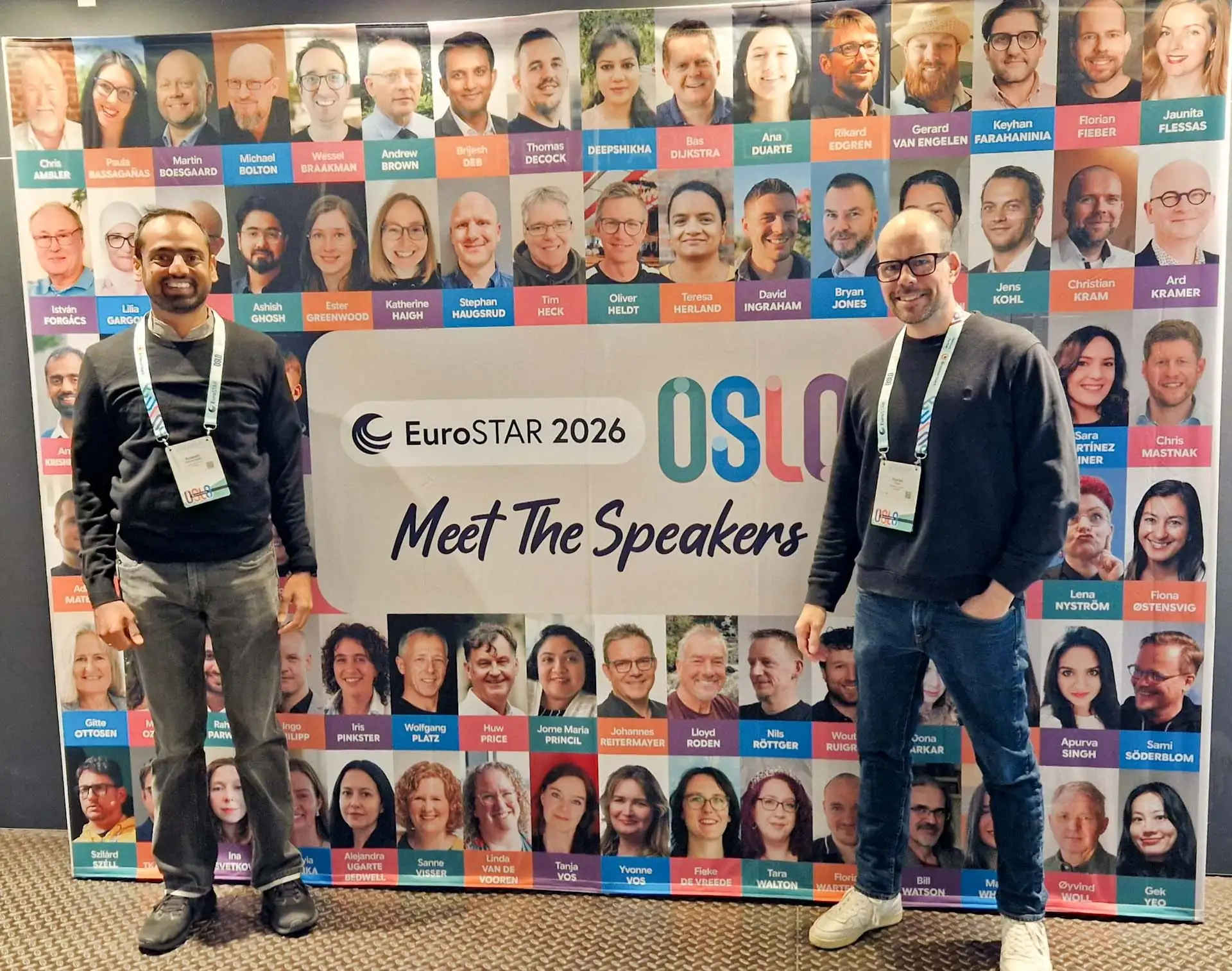
EuroSTAR is Europe’s largest software testing conference, with over a thousand attendees. This year, TestSolutions was represented by two speakers:...

1 min read
There have always been promising trends in software testing since the 1990s. From the automation wave of the 1990s and the focus on process models to...
 Anupam Krishnamurthy