


 Sabri Deniz Martin
1 min read
AI-powered performance testing: How to prepare your systems for the future
In today's highly networked digital ecosystems, user expectations are immensely high. A delay of just 500 milliseconds can already significantly...

Practical. Proven to success. Tailor-made. Learn more about our case studies.
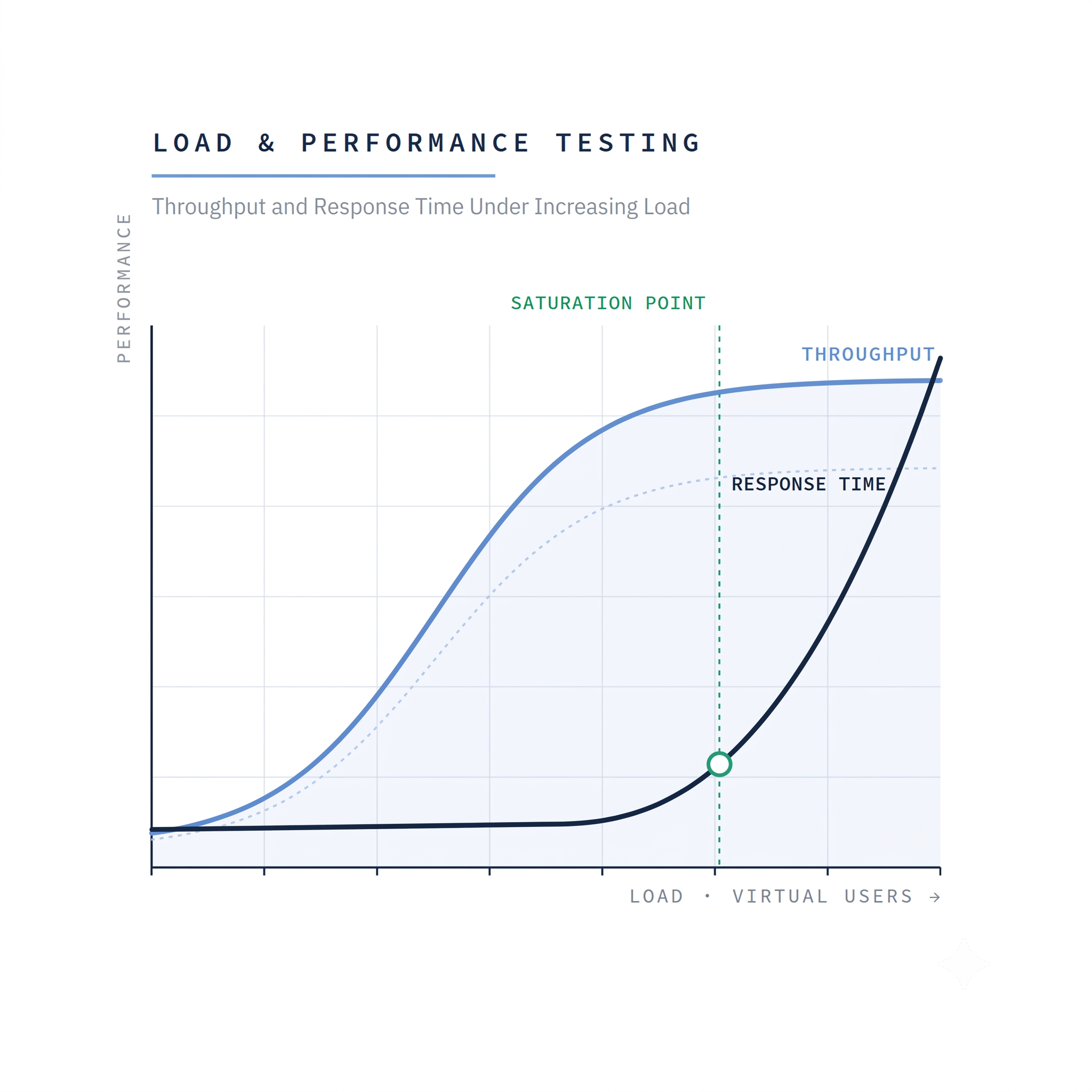
A system may operate flawlessly during functional testing but still fail under real-world load. Often, the cause lies not in a single component, but in the interaction between microservices, APIs, databases, networks, and cloud resources. Slow database queries, limited connection pools, delayed auto-scaling processes, or overloaded interfaces can exacerbate each other’s effects.
Load and performance tests reveal such dependencies and bottlenecks before they impact production operations. This guide introduces seven key services that enable companies to test complex systems under realistic conditions and ensure their stability under peak loads.
A load test simulates a defined volume of usage or transactions, such as concurrent users, requests per second, or business processes per hour. It measures whether the system meets the specified targets for response time, throughput, error rate, and resource utilization under this load.
Load tests are a form of performance testing. The umbrella term also includes, among others, stress, spike, sustained load, and scalability tests. The types of tests required depend on the business processes, technical risks, and expected usage patterns.
In distributed architectures, an application’s perceived performance depends on many components and dependencies. A single transaction can pass through multiple services, databases, message queues, and external APIs. This results in error patterns that are difficult to detect in isolated component or functional tests.
Typical risks include:
A meaningful load test therefore does not merely consider the response time at the user interface. It correlates technical metrics along the entire processing chain and reveals the root cause behind an observed delay or error rate.
Before the first test run begins, two interrelated foundations are needed: a test strategy and a test concept derived from it.
The test strategy defines the overarching approach. It determines which test types are combined based on risk, which business processes are particularly critical, and which quality objectives must be met.
The test concept translates this strategy into a concrete plan for the respective system. It describes the system landscape, test environment, load profiles, test data, measurement points, acceptance criteria, responsibilities, resources, and the timeline.
TestSolutions develops strategies and test concepts tailored to individual business requirements and technical constraints. This process draws on experience from complex and regulated industries where stability, traceability, and reliable test results are particularly important.
Load tests evaluate the system under an expected or defined load. Stress tests increase the load beyond normal operational limits to determine when performance targets are no longer met and how the system responds to overload in a controlled manner.
The determined load limit is not a universal characteristic of the application. It always applies to the specific configuration, environment, database, and load profile used in the test.
Realistic results can only be achieved if the load model reflects actual usage. This includes different user paths, transaction ratios, response times, data variations, concurrent sessions, and load trends over time. A high number of virtual users alone does not constitute a meaningful load test.
Bottleneck analysis identifies components or dependencies that limit throughput, increase response times, or cause errors under load. Resource profiling provides metrics such as CPU utilization, memory consumption, I/O, network latency, and utilization of technical pools.
A bottleneck can rarely be determined based on a single metric. High CPU utilization may be the cause of a problem, but it may also simply be the result of inefficient processing. Therefore, load profiles, response times, error rates, infrastructure metrics, logs, and traces must be correlated over time.
The goal is not merely to identify a bottleneck. A robust analysis explains the conditions under which it arises, which business processes are affected, and which measures are likely to have the greatest impact. After optimization, a retest should verify whether performance has actually improved and no new bottlenecks have emerged.
Scalability tests examine how system performance changes as load or available resources increase. Capacity planning uses these results to estimate resource requirements for expected growth and defined peak loads.
Horizontal scaling involves deploying additional instances or servers. Vertical scaling involves providing an existing instance with more processing power, memory, or other resources. In both cases, the performance increase is not automatically proportional: databases, shared caches, external systems, or serial processing steps can limit scalability.
Scalability tests answer the following questions, among others:
Data-driven capacity planning helps avoid both costly overcapacity and risky resource bottlenecks. It should be updated regularly as architecture, data volumes, user behavior, or business forecasts change.
API performance tests measure response times, throughput, error rates, and the stability of interfaces under defined concurrent loads. They show whether APIs meet their performance targets even with many simultaneous requests and complex process chains.
APIs connect user interfaces, microservices, partners, customers, and external platforms. A slow API call can therefore delay an entire transaction. It is particularly important to test endpoints with high traffic volumes, large amounts of data, complex business logic, or dependencies on third-party systems.
API testing can include functional, performance-related, and—using appropriate methods in each case—security-related tests. Performance and security tests have different objectives and should be clearly distinguished from one another in terms of methodology.
Cloud load testing verifies whether applications operate stably and cost-effectively under dynamically allocated resources. The focus is on auto-scaling, distributed components, elastic infrastructure, failure scenarios, and costs under various load conditions.
The cloud facilitates the deployment of large load generators but does not automatically make realistic testing easier. Results can be influenced by dynamic resource allocation, managed services, quotas, multi-tenancy, or network connections between regions and availability zones.
Before a test, permitted load profiles, test windows, and the respective cloud provider’s guidelines must be reviewed. Equally important are effective cost monitoring and clear termination criteria to ensure that unexpected scaling does not lead to uncontrolled expenses.
Continuous Performance Testing integrates repeatable performance checks into the development and delivery process. This allows performance regressions to be detected earlier, rather than becoming apparent only shortly before a release or during production operation.
Not every performance test is suitable for every commit. Lightweight tests can run with every build or pull request. Resource-intensive load, stress, and sustained-load tests, on the other hand, are usually scheduled and executed in dedicated test environments or prior to defined releases.
Automation requires versioned test scripts, reproducible test data, stable environments, and measurable thresholds. A test should fail not only when technical errors occur, but also when defined performance budgets are exceeded.
Suitable tools include JMeter, k6, Gatling, NeoLoad, or LoadRunner. The choice depends, among other factors, on architecture, protocols, toolchain, licensing model, and required scalability. What matters is not the tool alone, but the combination of a realistic load model, reliable measurement, and expert analysis.
Our Load and Performance Testing Services:
The most important metrics are response time, throughput, error rate, and resource utilization. They must be evaluated together and in the context of the respective business process.
| Metrics | Description |
|---|---|
| Response time | Time between a request and a complete response; in addition to the mean, consider percentiles such as p95 and p99 |
| Throughput | Successfully processed transactions, requests, or data volumes per unit of time |
| Error rate | Proportion of operations that failed, were aborted, or timed out |
| Concurrency | Number of concurrent users, sessions, connections, or transactions |
| Resource utilization | Utilization of CPU, memory, network, storage, pools, and other technical resources |
| Saturation | The degree to which a limited resource is utilized, causing additional work to be queued |
Average values alone can mask critical outliers. Therefore, percentiles are often relevant for user-specific response times. For example, the 95th percentile indicates the value below which 95 percent of the measured response times fall.
A suitable service provider should not only generate load but also understand business processes, evaluate the testability of the architecture, and translate measurement results into actionable recommendations.
| Criterion | Why it’s important |
|---|---|
| Experience with complex systems | Distributed architectures require the analysis of technical dependencies and complete process chains. |
| Industry experience | Usage patterns, regulatory requirements, and documentation obligations vary by industry. |
| Methodology and Tool Expertise | Tools must be compatible with the architecture, protocol, toolchain, and test objectives. |
| Monitoring and Analysis Expertise | Only by correlating load, metrics, logs, and traces can a robust root cause analysis be performed. |
| Scalable Capacities | Large or recurring tests require sufficient infrastructure and experienced test teams. |
| Transparent Reporting | Results must be traceable and include concrete, prioritized recommendations for action. |
| Flexible collaboration | The testing approach should be able to integrate into existing development, operations, and release processes. |
Performance testing is the umbrella term for tests that evaluate a system’s response time, throughput, stability, and resource consumption. A load test is a specific type of performance test that evaluates the system under a defined load.
Other forms include, for example, stress tests, spike tests, sustained load tests, and scalability tests.
A load test checks whether the system can handle an expected or agreed-upon load within defined performance targets. A stress test increases the load beyond that to examine system limits and behavior under overload conditions.
Load tests should be performed before major releases, after performance-related architecture or infrastructure changes, and before expected traffic spikes. In agile development environments, it is also recommended to implement a phased continuous performance testing approach, consisting of small, frequent checks and more extensive tests at scheduled intervals.
Depending on the type of test, the actual test execution can take anywhere from a few minutes to several days. However, the total effort also includes requirements analysis, load modeling, script creation, test data preparation, environment setup, monitoring, evaluation, and retesting. For complex systems, the preparation is often more time-consuming than the actual test run.
The required number is determined by the actual or projected usage pattern. What matters is not having as many virtual users as possible, but rather the right combination of concurrency, transaction frequency, response times, process shares, and data volume. Depending on the application, a small number of high-frequency API calls can generate more load than a large number of inactive sessions.
Load tests in the production environment are generally possible, but should only be conducted under strictly controlled conditions. This requires coordinated test windows, continuous monitoring, appropriate test data, clear termination criteria, and rollback and emergency plans. All responsible operational units must be involved. Data protection, security, and compliance requirements must be taken into account.
A staging environment close to production is often the lower-risk alternative. However, its results are only reliable if the architecture, configuration, data volumes, and relevant dependencies reflect the production environment with sufficient accuracy.
The environment should closely resemble the production environment in terms of performance-relevant characteristics. These include architecture, configuration, data volume, network paths, external dependencies, and scaling rules. If the test environment is smaller, the differences must be documented and taken into account during interpretation. A simple linear extrapolation is usually not reliable for complex systems.
A load test is successful if the system can consistently process the defined load profile while meeting all specified acceptance criteria. These include, for example, thresholds for response times, throughput, error rates, and resource utilization. The test environment must remain stable during the run and be documented in a traceable manner.
Professional load and performance testing are an essential part of software quality assurance. The seven services presented—ranging from test strategy to bottleneck analysis and cloud testing to CI/CD integration—help companies identify performance risks early on and make informed decisions about optimization and capacity.
TestSolutions supports companies in planning, executing, and evaluating load and performance tests for complex systems. This includes realistic load models, reproducible test procedures, technical root cause analyses, and concrete recommendations for action. Many years of experience in industries such as aviation, financial services, and healthcare combine testing expertise with an understanding of critical business processes and regulated environments.
Would you like to know how your systems respond under load?
Contact TestSolutions for a no-obligation initial consultation regarding your load and performance tests.


1 min read
In today's highly networked digital ecosystems, user expectations are immensely high. A delay of just 500 milliseconds can already significantly...

1 min read
This guide provides a detailed overview of how to perform performance tests (load tests) with NeoLoad using a simple example application JPetStore....

3 min read
In the world of performance testing, change is the only constant. While protocol-based recording has been the standard method for decades, the ...