


1 min read
Car.HMI Europe 2026: Two days in Berlin
 Sabri Deniz Martin
On June 22 and 23, 2026, our colleagues Vittorio Monteiro and Sabri Deniz Martin attended Car.HMI Europe at the Hotel Titanic Chaussee in Berlin. The...

Practical. Proven to success. Tailor-made. Learn more about our case studies.
6 min read

What happens when a navigation system thinks you're driving on a road that doesn't even exist? Or if the Estimated Time of Arrival, ETA for short, is off by 25 minutes - in the middle of a major European city during the well-known rush hour?
Such questions can only be answered to a limited extent on a test bench in the laboratory. Real road conditions are needed.
At TestSolutions, we test software. Mostly in the office, on test systems, with tickets in Jira and test cases in Excel. But in automotive projects, we also test where navigation and infotainment systems will actually be used later: in the vehicle, in traffic, on city highways, in European metropolitan regions, in high-turnover sales regions, on side roads, at traffic circles and in front of charging stations.
This article explains why field acceptance testing is not an optional extra for OEMs and Tier 1 suppliers - but a central component of systematic quality assurance.
When you think of a navigation system, you usually think of a map and a voice that tells you where to turn. That's the visible part. There are several layers underneath that have to work together reliably:
Each of these layers can contain errors. And many of them only become apparent when the system is actually used in the vehicle.
For quality assurance, this means that it is not enough to test individual functions in isolation. The decisive factor is how the overall system reacts under real conditions - in other words, when map data, live data, vehicle hardware, user interaction and the traffic situation interact simultaneously.
Test benches are indispensable in automotive QA. They enable reproducible tests, early fault detection and structured tests before a system is validated in the vehicle. Real and simulated ECUs can be combined on test benches and test environments in order to test embedded infotainment systems realistically.
That is valuable, no question.
But a test bench simulates. It cannot fully replicate what happens on a real road: an unexpected roadworks that the navigation system ignores. A traffic circle that the database misclassifies. A charging station that is available according to the app - but is blocked or out of order on site. A route that was technically calculated correctly but is barely comprehensible for the driver.
Physical reality is the toughest test case.
The added value therefore does not lie in either-or. Good automotive QA combines both: structured tests on the test bench and field acceptance testing in real driving conditions.
When we test live, we work as an acceptance test team. We look at the system from the end user's perspective - not just from the development perspective. This view is important because many errors are not related to a single function, but to the context of use.
In concrete terms, it looks like this:
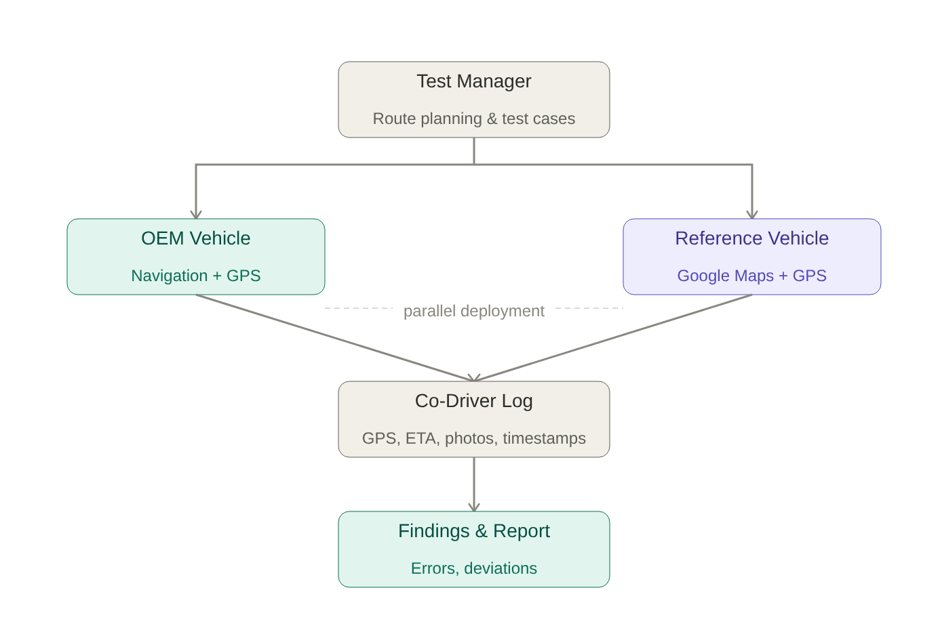
Two vehicles, two systems.
One vehicle uses the OEM's navigation system, the other an established reference solution. Both vehicles are equipped with GPS trackers that continuously record position data. This allows deviations between the calculated and actual route to be fully documented.
Structured test cases, flexibly adapted.
The test manager prepares routes - from A to B, with defined parameters. At the same time, the team must be able to react to traffic, weather, road closures or other real-life conditions. Because that's exactly what the real driver does. Test coverage takes precedence over rigid process adherence.
Documentation while driving.
The co-driver or test attendant documents the results directly during the journey: time of route calculation, departure time, calculated and actual ETA, observations, deviations, GPS coordinates, screenshots and photos of the situation on site. Nothing is reconstructed from memory afterwards.
Benchmarking.
How well does the OEM system perform compared to a reference solution? Where does it deviate - and is this an error, a data deviation or a deliberate design decision?
This last point is particularly important: not every deviation is automatically a bug. Sometimes systems prioritize different criteria - for example, shortest route, fastest route, energy consumption, charging options or traffic density. Field acceptance testing helps to make such differences visible, assessable and decidable.
Over several years and in various European metropolitan regions - including central urban markets, heavily frequented commuter regions and high-turnover sales areas - it has become clear that there is a wide range of possible findings: The range of possible findings is wide.
Typical examples from such test series are
Each of these findings has consequences: for the user experience, for customer satisfaction and for the brand.
For the driver, it is ultimately not important whether the error lies in the map database, in the backend, in the route logic or in the integration. What matters is whether the system works reliably. This is precisely why such errors must be tested in interaction.
Field acceptance testing is particularly valuable when multiple data sources, system components and suppliers are involved. The more interfaces a system has, the greater the likelihood that errors will not occur in a single component, but in the interaction between them.
From a QA perspective, five questions are particularly important:
1. are we only testing functions - or also usage situations?
A navigation system can function formally correctly in the laboratory and still deliver poor results in everyday use. Real usage situations show whether the system is comprehensible and reliable for the driver.
2. are our test regions representative?
Not every region has the same requirements. Dense city centers, commuter corridors, border regions, charging infrastructure and high-turnover markets should be specifically taken into account.
3. can we clearly document deviations?
GPS tracks, time stamps, screenshots and photos make findings traceable. Without reliable documentation, a genuine error quickly becomes a subjective observation.
4. do we compare against a meaningful reference?
Benchmarking against established reference systems helps to classify deviations. The aim is not to copy every behavior, but to understand and evaluate differences.
5. do the results flow back into development and data quality?
Field testing is only effective if findings do not remain isolated. They need to be translated into map updates, backend improvements, route logic, UI adjustments or supplier feedback.
Vehicles today are driving software platforms. Navigation and infotainment systems are no longer developed exclusively by OEMs themselves. Tier 1 suppliers and specialized technology partners supply entire system components. This results in more interfaces, more potential sources of error and more integration complexity.
This is a clear requirement for suppliers: anyone supplying a system to an OEM must be able to prove that it works in real driving conditions - not just on paper, in the laboratory or on the test bench. Test drives with a structured acceptance character are a key instrument for this.
The same applies to OEMs: before a new vehicle is launched on the market, it must be ensured that the navigation system - including all database and live data components - meets customer expectations. This is not a question of trusting the supplier. It is systematic quality assurance.
Our strength lies in the combination of structured software QA and practical automotive experience. We not only test against specifications, but also check how systems work under real conditions: in the vehicle, in traffic, with changing data situations and with a view to the actual user experience.
This includes tests of navigation databases, live data, eMobility services, infotainment components and charging infrastructure. The decisive factor here is not just whether a system works technically, but whether it delivers reliable results in the real context of use.
We know the complexity of embedded systems, the requirements of the OEM environment and the reality of driving.
Test drives are not an excursion. They are a methodically sound part of field acceptance testing - with clear test cases, comprehensible documentation and measurable results.
If you want to accept navigation software or other in-vehicle systems, there is no way around real road conditions. For OEMs and Tier 1 suppliers who want to validate navigation systems under realistic conditions, field acceptance testing is not an additional expense, but a decisive proof of quality.
Are you planning acceptance tests for a navigation or infotainment system in the field? Then we would be happy to talk to you about which test scenarios make sense and where real road conditions make the difference.


1 min read
On June 22 and 23, 2026, our colleagues Vittorio Monteiro and Sabri Deniz Martin attended Car.HMI Europe at the Hotel Titanic Chaussee in Berlin. The...

1 min read
The airline industry is facing an epochal change. With the IATA-driven transition to airline retailing systems such as NDC (New Distribution...

15 min read
Artificial intelligence has reached a significant milestone with the launch of ChatGPT at the end of 2022 at the latest and is now generally...
 Florian Fieber