
Skip to the main content.

1 min read

The “Split-Brain” Transition in Airline Retailing

The “Split-Brain” Transition in Airline Retailing

The aviation industry is undergoing one of the most far-reaching transformations in its history. Concepts such as NDC and ONE Order promise a completely modernized world of retailing. But the reality is currently very different.

Most airlines are caught between two system worlds.

They are neither fully anchored in the legacy model nor have they fully arrived in the new retailing world. Instead, many operate in a hybrid system landscape that can be described as a "split-brain" state.

From legacy system to airline retailing

Traditional airline systems are based on:

  • Passenger Name Records (PNRs)
  • Filed Fares (e.g. ATPCO)
  • Ticketing via ET/EMD
  • Batch-driven processes

These systems are stable, but only flexible to a limited extent.


New airline retailing approaches, on the other hand, are based on:

  • Dynamic real-time pricing
  • Personalized offers
  • Order-based data models
  • Event-driven processes

This change enables innovation, but brings with it new integration and quality risks.


The reality: Hybrid airline system landscapes

A complete switchover is currently not realistic.

Instead, hybrid architectures are emerging:

  • Legacy systems remain in place for central processes
  • New retailing components complement existing structures

This coexistence leads to complex integration requirements.


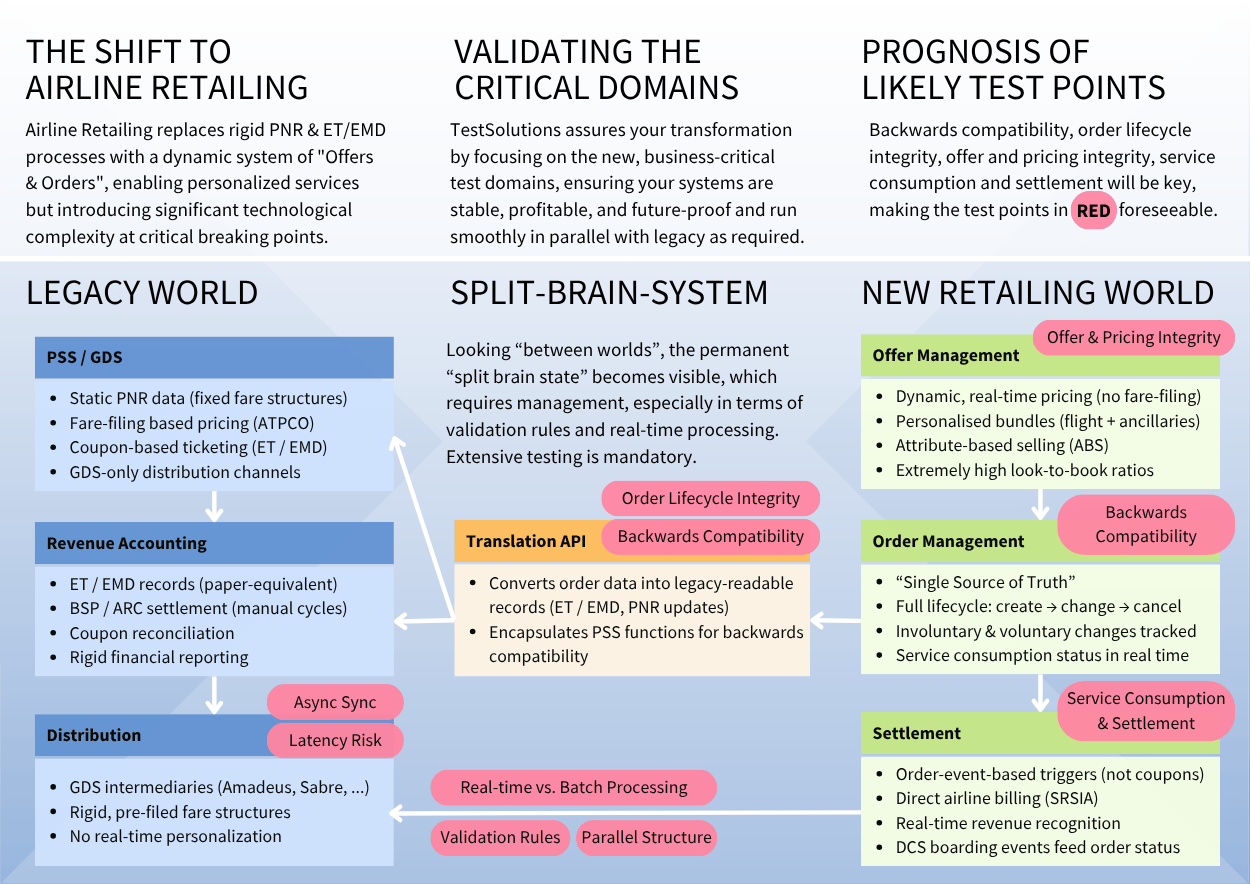
Visualization of the "split-brain"

Diagramm einer hybriden Airline-Systemlandschaft mit Legacy-Systemen (PNR, Ticketing) und modernen Retailing-Komponenten (Offers, Orders, Dynamic Pricing) sowie Integrationsschichten zwischen beiden Welten.

Figure: Split-brain system architecture in airline retailing


Where the greatest risks arise

The biggest challenges arise at the interfaces between legacy and retailing systems.

  1. Backward compatibility
    New systems must remain compatible with existing processes.
  2. Order lifecycle management
    Dynamic changes must remain consistent across systems.
  3. Dynamic pricing
    Real-time pricing increases complexity and susceptibility to errors.
  4. Real-time vs. batch
    Different processing logics lead to synchronization problems.
  5. Settlement & billing
    New models are fundamentally changing financial processing.


Why the "split-brain" phase is critical

This transition phase is not an exceptional situation - it is the norm for the next few years.

Airlines must simultaneously:

  • Drive innovation
  • ensure stability
  • continue to operate existing systems

This creates increased risks for data consistency, revenue security and customer experience.


Testing as a decisive success factor

Traditional test strategies are no longer sufficient.

What is needed is

  • End-to-end tests across system boundaries
  • Validation of data consistency
  • Testing of real-time processes
  • Validation of integration layers
  • Validation of financial processes

Testing is thus becoming a key lever for successful airline transformation.


For the future, this means

The transformation to modern airline retailing is irreversible,but airlines are currently operating ina hybrid system world in which legacy and new technologies must function simultaneously.

Success depends not only oninnovation, but also on how well these systems are integrated,because the biggest challenge is to ensure that both worlds work together reliably.


This is where we can help you with our airline expertise.

Blog