


 Sabri Deniz Martin
1 min read
Testing AI Governance: EU AI Act compliance requires evidence, not stacks of paper.
 Balamurali Boggu
In most AI projects, governance and testing tend to be handled separately. Documentation is required for compliance purposes. Testing validates the...

Practical. Proven to success. Tailor-made. Learn more about our case studies.

The go-live has been approved, the business requirements have been met, and almost all indicators in the project status report are green. One question still remains: how will the software behave when many people use it at the same time in production, when an interface returns unexpected data, or when a critical business process runs differently than intended?
If those risks only become visible after the release, the work is rarely limited to fixing individual defects. Delayed processes, unavailable services, faulty transactions or inadequately protected data can cause significant business damage. At the same time, the trust that customers and employees place in the application, and often in the company behind it, is undermined.
As neutral third parties, test consultants help to identify these risks early and systematically. They combine methodical testing expertise with an independent view of business processes, system landscapes and quality requirements, usually built on in-depth industry knowledge. This creates a solid basis for decisions at the intersection of IT and business.
External or additional testing expertise becomes valuable when existing quality assurance can no longer keep pace with the complexity, risk profile or speed of a project.
Typical signs include:
In these situations, test consultants do more than add capacity. They help to structure risks, prioritize test activities and assess the quality level transparently.
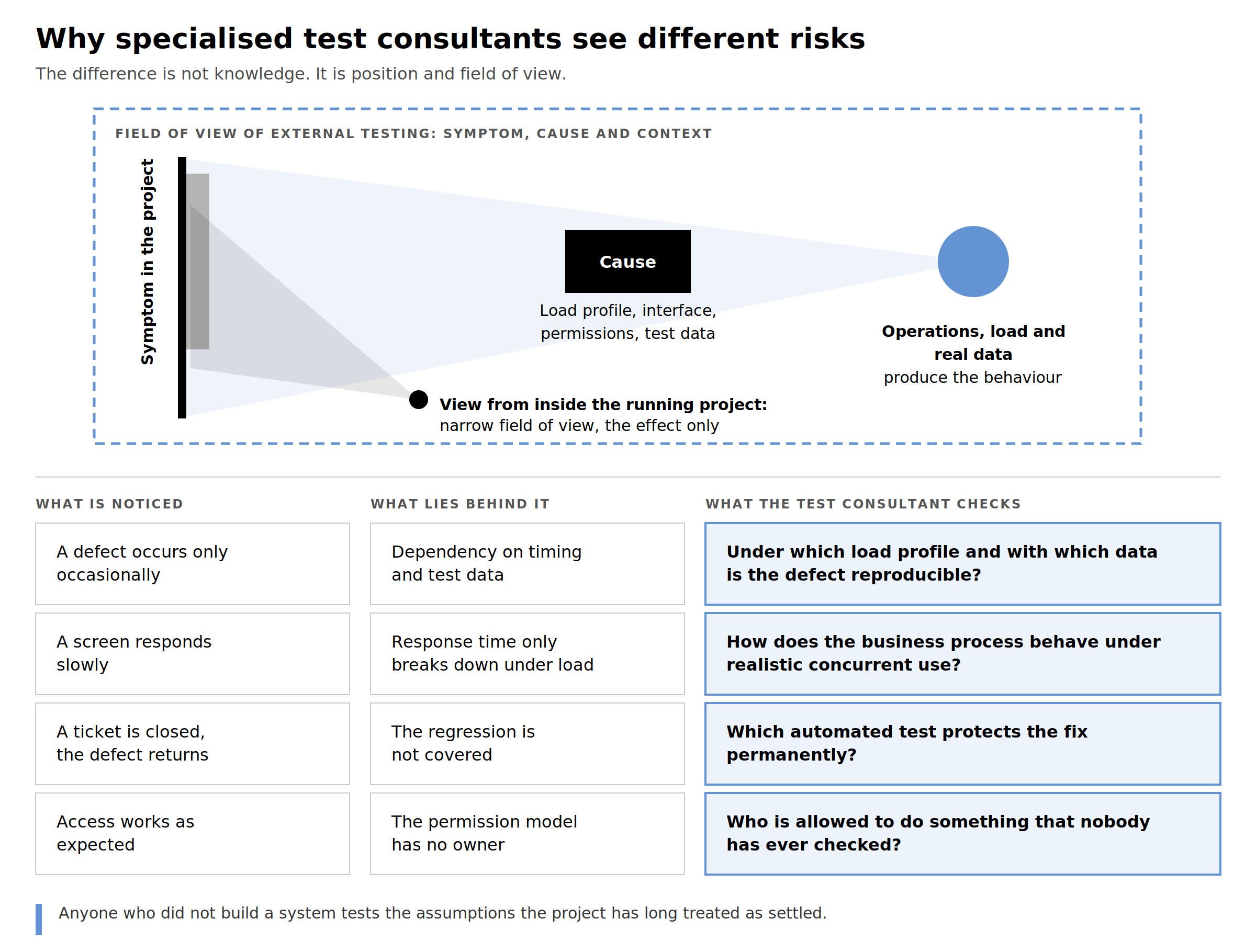
Development-oriented testing is indispensable. It verifies early whether individual components and functions work as intended from a technical standpoint. Comprehensive quality assurance complements those tests with an independent, overarching perspective.
Test consultants look at the application from the perspective of the entire business process. This usually requires in-depth knowledge of your industry. They check not only whether a function works in principle, but also under which conditions it could fail and what the consequences would be.
This includes unusual usage scenarios, invalid input, dependencies between systems, different roles and permissions, and disruptions in upstream or downstream processes.
This independent perspective does not create distance from the project, it adds transparency. Effective quality assurance comes from the collaboration between business, IT, product managers, development leads and testing. Test consultants contribute specialized methods and ask the specific questions that are otherwise easily overlooked in day-to-day project work.
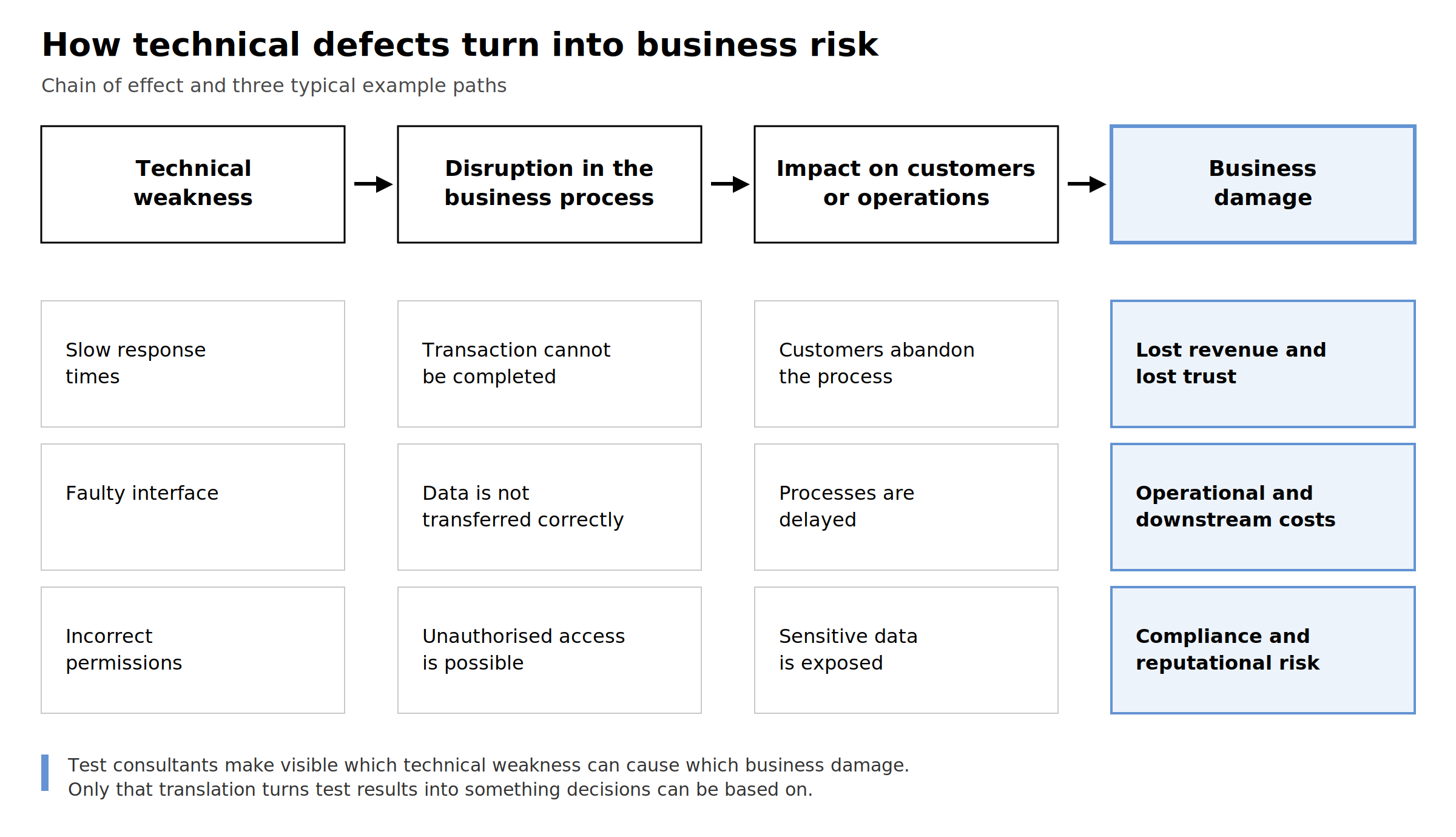
Software quality is more than technically correct results. An application can fulfill every intended function and still cause serious problems in production.
Typical scenarios include:
Professional software testing translates these technical findings into business terms. What matters is not how many defects were found, but what risks they create for availability, revenue, compliance, operations and customer trust.
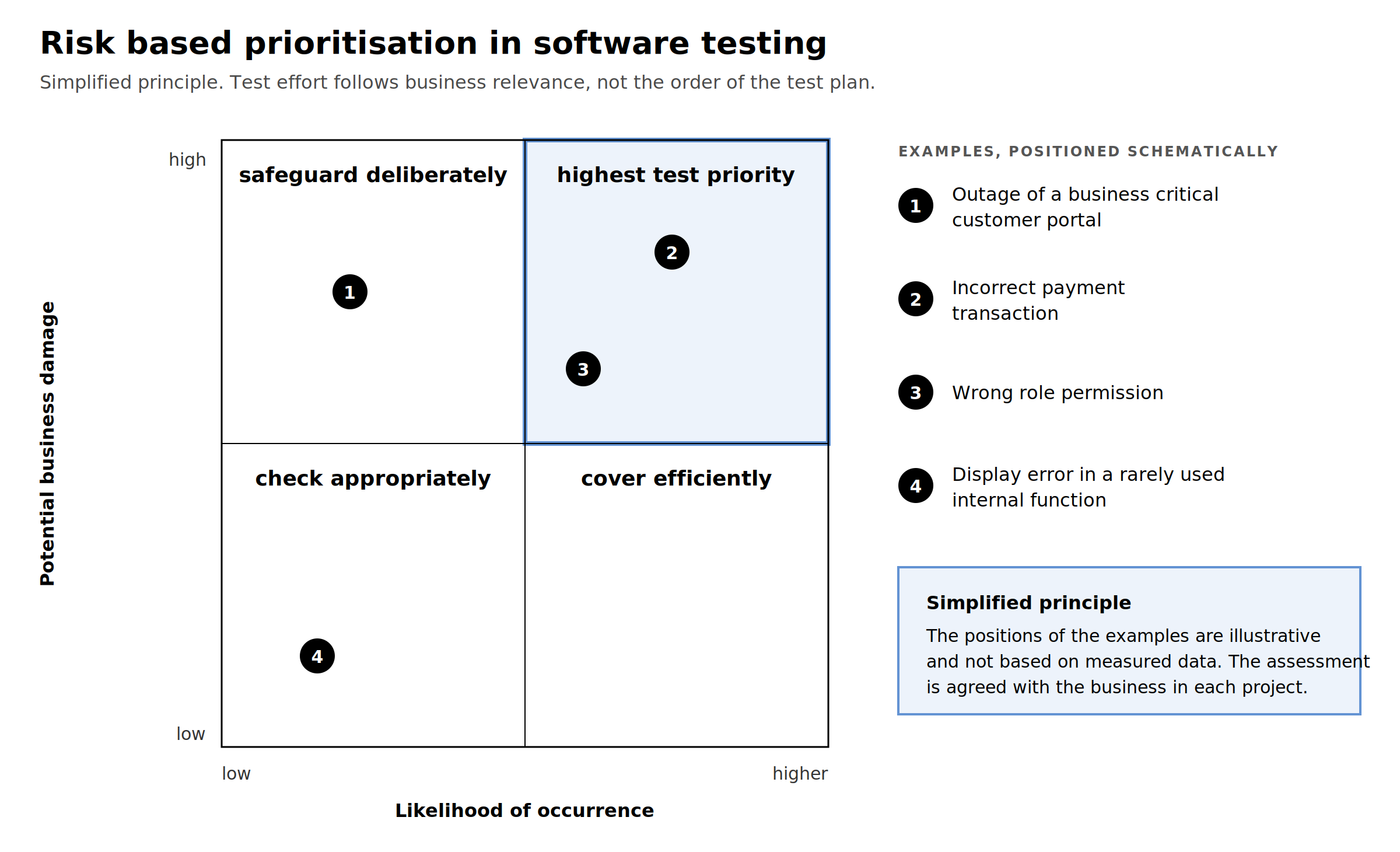
Not every function is equally critical, and not every defect causes the same damage. That is why test consultants do not derive their test strategy from technical specifications alone. They also weigh the importance of the business processes involved.
Among other things, they ask:
The answers form the basis for a risk-based test strategy. Critical processes are given higher priority, and the available resources go where a failure would cause the most damage. The result is a picture of quality that goes beyond a list of technical defects and supports informed release and investment decisions.
The quality assurance process for a data migration in private banking shows how closely IT and business are connected here. Data from around 10,000 private clients had to be migrated on time, in full and in line with regulatory requirements. Test management, data mapping, system integration tests, user acceptance tests and migration dry runs were combined into one continuous process.
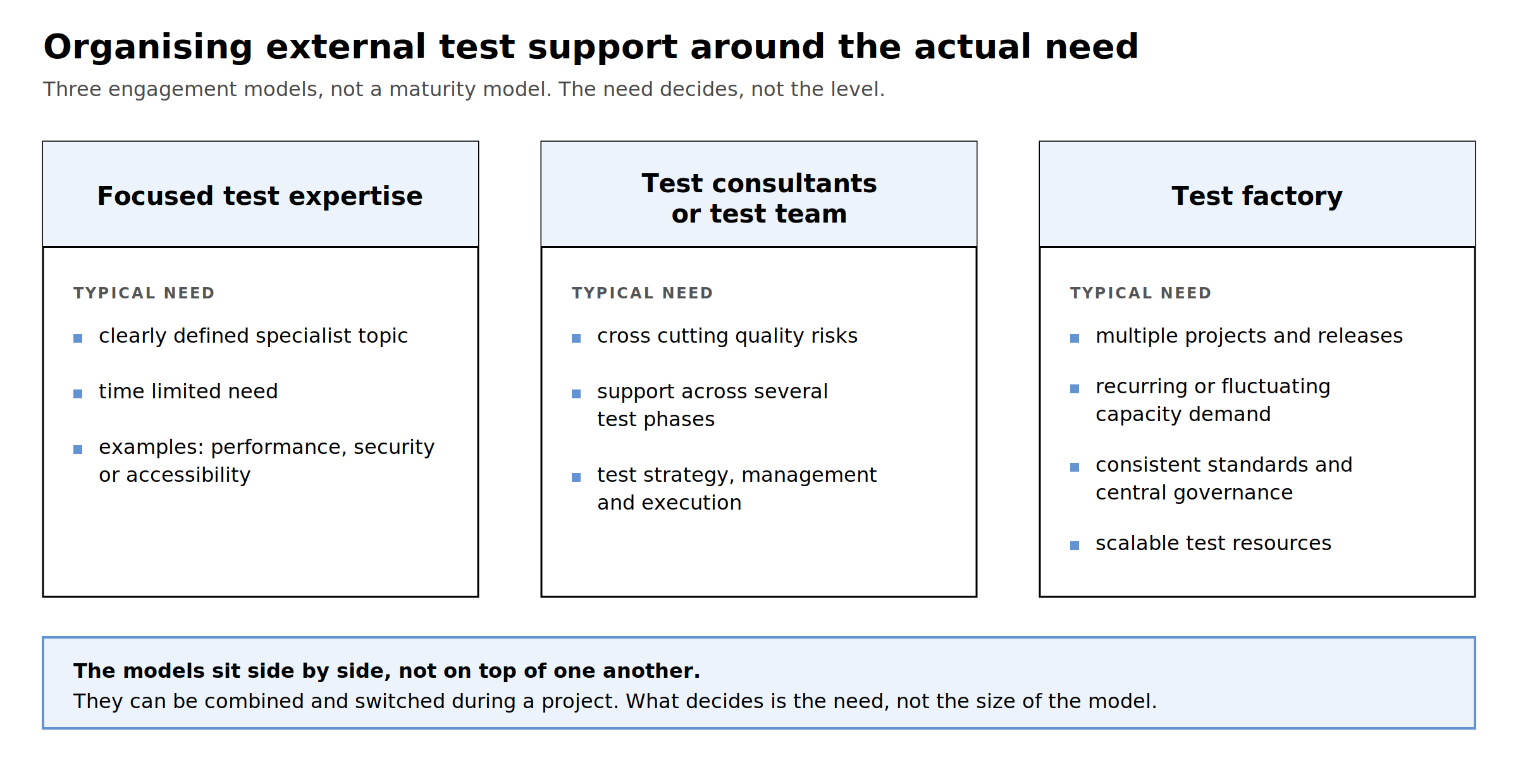
The actual scope depends on the system, the risk profile and the existing organizational structure. Test consultants can take on individual specialized tasks, extend existing teams or coordinate quality assurance across several projects.
Typical services include:
The value does not come from running as many test types as possible at once. What matters is the right combination for the actual business risks. For clearly defined specialist areas such as performance, security or accessibility, external expertise can be useful case by case. For cross-cutting quality risks, test consultants support strategy, management and execution.
The testing of a fintech payment platform is one example. For this multi-platform solution, the team combined manual testing, API testing and test automation. The test team was integrated into the sprints early on, in order to verify functionality, data flows, security, performance and usability continuously.
Further examples from various industries and testing disciplines can be found in the TestSolutions case studies.
When several projects or releases run in parallel, ad hoc support from individual specialists is not always enough. A Test Factory can then be the appropriate operating model.
A Test Factory consolidates testing services into a centrally managed, scalable structure. Standards, roles, processes, tools and quality criteria are aligned across projects. The company retains subject-matter control and governance, while the required test capacity and specialist expertise are provided as needed.
This model is particularly suitable when:
A Test Factory is therefore not an outsourced final inspection. Set up properly, it embeds quality assurance continuously into the value chain and combines central control with flexible execution. It can complement internal expertise without relieving the company of its responsibility for quality goals and release decisions.
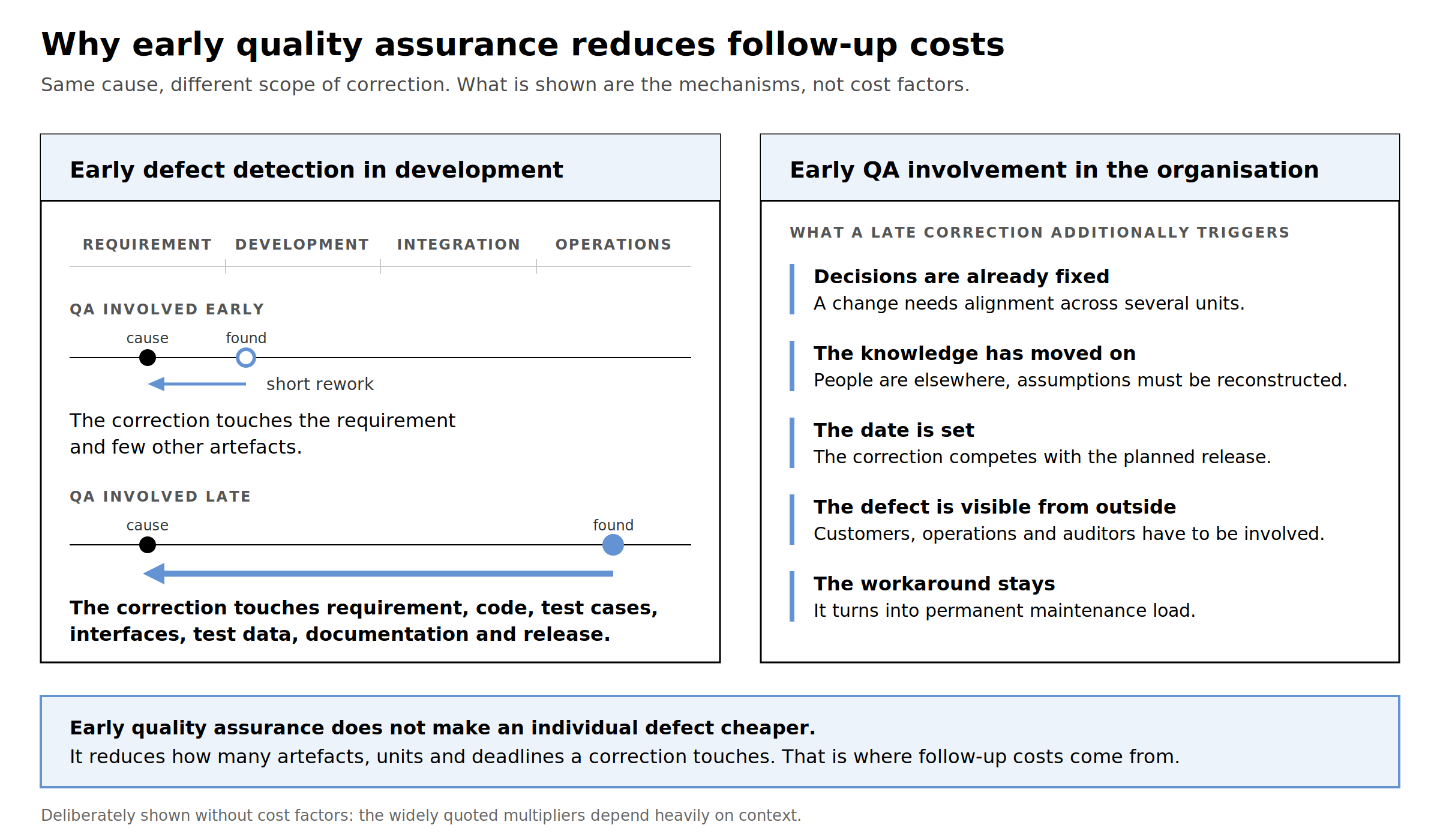
The later a defect surfaces, the more systems, processes and people are already affected by it. A misunderstanding in a requirement can often still be corrected during the analysis phase with manageable effort. If the same problem is only found when the system goes live, the technical fix comes on top of operational disruption, support effort, rework, regulatory risk and lost trust.
Test consultants are therefore involved as early as possible. They review requirements for clarity and testability, identify critical business processes, develop suitable test scenarios and lay the groundwork for continuous testing. Testing then becomes an ongoing source of reliable quality information rather than a final check before the release.
This does not mean testing every conceivable scenario exhaustively. The goal is to focus the available resources deliberately on the greatest risks and to reduce uncertainty before important decisions are made.
Specialized test consultants do more than confirm that software works in principle. They examine whether business-critical processes stay reliable under realistic and unexpected conditions, whether interfaces and data flows remain stable, and whether the relevant requirements for performance, security and usability are met.
That gives companies transparency about technical and business risks. They can assess releases more thoroughly, take specific load off internal teams and deploy specialist knowledge exactly where it is needed. For larger or continuously parallel testing needs, a Test Factory can additionally provide standardized procedures, scalable capacity and reliable management.
TestSolutions helps companies find the right approach for their system landscape, their business risks and their existing structures, from targeted test consulting and individual specialist consultants through to full Test Factory services. A no-obligation consultation can show where the greatest quality risks lie and what the next sensible step is.
Not sure which model best suits your needs?
We'll assess your quality risks together before discussing the scope.

.webp)
1 min read
In most AI projects, governance and testing tend to be handled separately. Documentation is required for compliance purposes. Testing validates the...
1 min read
What happens when students hear for the first time that quality assurance isn’t just about fixing bugs? That’s exactly what we experienced on June...

1 min read
AI is also finding its way into AI-powered software testing. In regulated industries, the reaction to this is often mixed: interest on the one hand,...